
logo dark logo light logo
  • Home
  • The experimental challenges
  • Publications
  • The PTOLEMY Collaboration
  • Media
  • LNGS-Wiki (private)
logo dark logo light logo
  • Home
  • The experimental challenges
  • Publications
  • The PTOLEMY Collaboration
  • Media
  • LNGS-Wiki (private)
mobile logo
  • Home
  • The experimental challenges
  • Publications
  • The PTOLEMY Collaboration
  • Media
  • LNGS-Wiki (private)
Ptolemy

COSMIC NEUTRINO BACKGROUND

Ptolemy

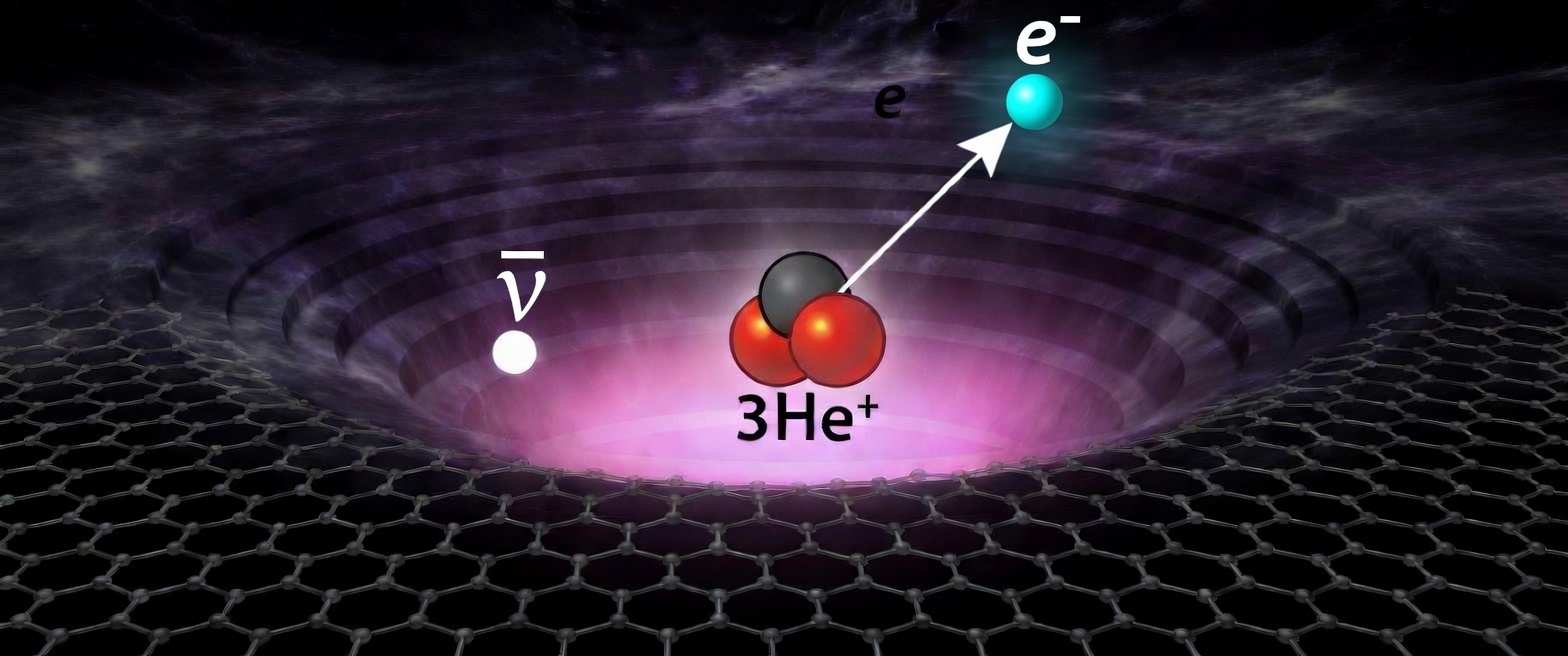
PTOLEMY aims to observe relic neutrinos from the earliest moments of the Universe. Capturing a snapshot of the first second after the Big Bang—when the Cosmic Neutrino Background (CNB) decoupled—has long been a dream of cosmology. PTOLEMY is designed to make this possible by detecting CNB neutrinos through their capture on a beta-unstable target. This process produces mono-energetic electrons with energies just above the beta-decay endpoint. However, the extremely small interaction cross section requires a large target mass, leading to a prohibitive background rate. To overcome this challenge, PTOLEMY employs a novel dynamic electromagnetic filter capable of selecting electrons only within the narrow energy region of interest, before the final high-precision energy measurement. The filter operates by exploiting coarse measurements of the electron kinematic variables. These are obtained by detecting the radio-frequency radiation emitted by electrons moving in a strong and uniform magnetic field. By dynamically adjusting the electric field of the filter, only electrons with the desired kinetic energy are transmitted. In addition to enabling the first direct detection of the CNB, the exceptional energy resolution of PTOLEMY opens the door to a search for the neutrino mass with unprecedented sensitivity.

PTOLEMY:

Supported by 2015-2021 MPS Targeted Grant Award from the Simons Foundation (US)

Supported by 2022-2025 John Templeton Foundation (US)

Supported by Research along Routes by Consortia 2019-2026, Dutch Research Agenda (NWA)

Supported INFN-CSN II in 2018-2020 (Italy), INFN-CSN V 2022-2025 (Italy), INFN-CSN II 2026- (Italy)